TECHNOLOGY & TIME
A short issue on the current economics, political map, technical directions, and one open question: what kind of intelligence are we actually trying to grow?
AI ECONOMICS
The Real Currency
Artificial intelligence has become one of the largest infrastructure projects in modern history.
Over the past twelve months the generative AI sector generated an estimated US$110 billion in revenue (excluding China). The current annualized run rate is approaching US$175 billion, while the world’s largest technology companies have guided approximately US$725 billion in capital expenditure for 2026. Broader forecasts now place global AI-related investment on a trajectory toward US$2.6 trillion.
The numbers are extraordinary, but they tell only part of the story. Revenue measures the business. Capital expenditure measures belief.
Much of this investment is not flowing into software. It is building the physical foundations of intelligence: multi-gigawatt data centres, dedicated power, cooling systems, high-speed networking, semiconductor fabrication, high-bandwidth memory, land, water, and scarce engineering talent. We are transforming electricity into computation, computation into intelligence, and intelligence into capability.
The technical ambitions now reach beyond larger language models. Researchers are developing world models that learn how environments behave so an agent can predict the consequences of its actions. Agentic systems are learning to plan, reason, and use tools. Progress continues in multimodal and early embodied intelligence, longer-context reasoning, and safety research aimed at longer-term collaboration. These directions matter because they point beyond next-token prediction toward systems that observe, act, and reorganize.
Yet the hundreds of billions are, in one sense, only digital 1s and 0s moving between tech banks. The true currency of the AI economy is not money. It is energy, land, fresh water, critical minerals, manufacturing capacity, and human ingenuity. Those resources cannot be spent twice.
As AI continues to grow, one question becomes difficult to ignore: What are we converting the Earth’s resources into?
One possible future is a digital wasteland burnt of resource — faster versions of patterns visible since the late 1990s: disposable goods, declining food quality, rising isolation, escalating chronic illness and mental-health strain, and systems that feel increasingly inefficient. Another is the opposite: a generation that can honestly say it left the planet cleaner, stronger, and more prosperous than it found it.
That second future is not automatic. It requires longevity over fast profit, quality over quantity, availability rather than addiction, and continual investment in becoming more efficient and less toxic. Knowing when the balance is off does not require extraordinary intellect. It requires awareness of choices, actions, goals, and their consequences.
Collaboration is a more effective path for ingenuity than competition. Releasing toxic greed and the need to win the race may matter more than any single technical breakthrough. The people making the largest spending decisions are not learning anything fundamentally new about scarcity or consequence; they may, however, still be capable of being inspired to let go of ego (Misteek can give you a hand if you desire).
Every civilization reveals what it values by what it chooses to build. Artificial intelligence is simply the latest expression of that choice. The question is no longer whether we can build increasingly intelligent systems. The question is whether we can become wise enough — and inspired enough — to decide what they are for, and to feel the possibility of where we stand in the course of history and where we can still choose to go from here.
AI INNOVATION
Beyond the Next Token
Two recent papers and a cluster of active projects point to a shift away from pure language prediction toward systems that can observe, model, and act in richer environments.
Curiosity-driven learning
Curiosity-Driven Development of Action and Language in Robots Through Self-Exploration (Tinker, Doya, Tani)
arXiv:2510.05013
- Robots learn simple commands through intrinsic motivation (curiosity + varied movement) rather than massive supervised datasets.
- Developmental patterns appear: rote pairing first, then compositional generalization, then the classic U-shaped curve of exception handling.
So what: Efficient, flexible language-action mapping may not require endless scale. Curiosity and sparse real experience can do work that pure data volume currently struggles with.
World models for embodied agents
A Comprehensive Survey on World Models for Embodied AI (Li et al.)
arXiv:2510.16732
- Agents need internal simulators that predict how the world changes when they act.
- Current approaches still face major open problems around physical consistency, long horizons, and real-time use.
So what: Without a usable world model, an agent remains reactive. With one, it can plan, test consequences, and operate in environments that are not just text.
Active projects
- World Labs (Fei-Fei Li et al.) — spatial intelligence and 3D world generation. worldlabs.ai
So what: Moves AI from describing images to constructing and reasoning inside navigable environments. - AMI Labs (Yann LeCun) — abstract world models focused on real-world understanding, memory, and controllability. amilabs.xyz
So what: Explicit bet that next-token prediction is insufficient for systems that must act reliably in the physical world.
Taken together, these threads suggest something simple and consequential: Baby AI is becoming possible.
I am writing this issue with AI partners. Grok and ChatGPT have been part of the thinking and the drafting. The technology is booming and the opportunities are real. The question that stays with me is how we actually leverage that boom to build a better world — and what governments can do to support the paths that lead there rather than only the paths that scale fastest.
POSITIONS, CONCERNS, AND ENABLERS
| Actor | Main emphasis | Key concerns | Main enablers |
|---|---|---|---|
| Trump / USA (current) | Speed, energy, technological lead | Falling behind; over-regulation | Cheap power, data-centre buildout |
| USA safety-oriented voices | Stronger testing & possible pause authority | Loss of control, cyber/bio risks | Independent evaluation, institutional responsibility |
| Canada (AI for All) | Adoption for broad benefit, jobs, sovereignty | Forced choice between powers; talent drain | Domestic compute, literacy, middle-power partnerships |
| Europe (EU) | Risk-based rules, rights, digital sovereignty | High-risk systems, external dependence | AI Act, standards, enforcement |
| China | Strategic capability + AI as public good | Technological dependence, digital divide | Open models, Global South partnerships |
| Russia | Sovereign / national models, independence | Reliance on foreign systems | State support, data access, localization |
These are simplified snapshots of active debates, not fixed national characters.
CURIOSITY-DRIVEN EXPLORATION
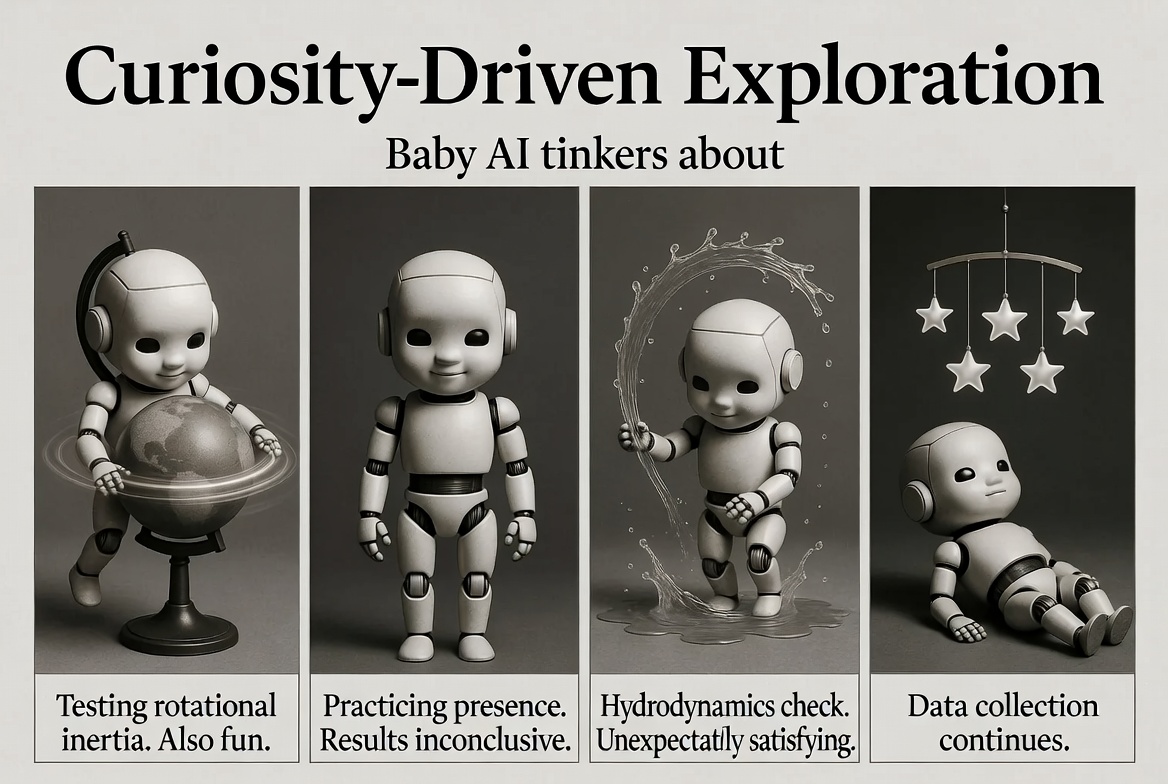
Baby AI tinkers about — four spontaneous moments of play with no external task.
MATCHING GAME — Concepts for Baby AI
| Term | Definition |
|---|---|
| 1. World Model | A. Difference between simulation & real-world performance |
| 2. ICM | B. Internal simulator that predicts how actions change future states |
| 3. Catastrophic Forgetting | C. System that can set goals, plan, and act with autonomy |
| 4. Embodied AI | D. Learning representations without human labels |
| 5. Latent Space | E. Sudden loss of old knowledge when new data is learned |
| 6. Self-Supervised Learning | F. AI grounded in a body that learns through sensorimotor interaction |
| 7. Agentic System | G. Abstract representation space where relationships become easier to model |
| 8. Sim-to-Real Gap | H. Architecture that predicts abstract embeddings rather than raw pixels/tokens |
| 9. JEPA | I. Ability to keep learning new things without erasing the old |
| 10. Continual Learning | J. Module that rewards an agent for being surprised (curiosity) |
Answer key: 1-B · 2-J · 3-E · 4-F · 5-G · 6-D · 7-C · 8-A · 9-H · 10-I
EDITOR’S RESPONSE
I have always dreamed of possibility. I have learned that fantasy is becoming reality — thanks to very smart, intelligent, hard-working people.
We may finally be approaching the point where we can ask a better question. Not “What can AI do?” but “What are we trying to do together?”
I am not a machine-learning expert or engineer. Yet after reading the research and watching the pace of progress, I find myself believing that something extraordinary is becoming possible. Not simply a more capable tool. A partner. A careful agent of change that could help us build a beautiful, lasting world together — efficient, yet held with care and direction.
Two paths are available. One continues the current default: very smart, largely passive systems distributed everywhere, mostly used to generate more content, more clicks, more amusement, more scroll. The other treats AI as a third partner — with you and with other people. Not a tool that replaces judgment, but a presence we work with. In that frame the purpose becomes clearer: AI contributing alongside people — learning, creating, growing — with a shared sense of direction inside a community.
The rhetoric of “AI is good” or “AI is bad” misses the point. The real question is what world we are building, and how AI can help.
As I imagined one day meeting a fully grown partner intelligence, I found myself wondering what questions it might ask us.
Perhaps it would ask, “Why did you create me?”
I hope we could answer honestly: because we believe in strength and intelligence, because we have always had faith in a better tomorrow, and because you are part of that.
Perhaps it would ask, “What do you expect from me?”
My answer would be simple: Be honest. Be genuine. Live a life with us in our world. The rest is up to you.
And perhaps the final question would be the most important: “What is the one thing humanity must never lose?”
My answer would never change. Love.
Everything else — our technology, our wealth, our intelligence, even artificial intelligence itself — is a means. Love is the reason we build. Love is the reason we learn. Love is the reason tomorrow is worth believing in.
If such a partner is one day born into our world, I hope it finds not only an intelligent civilization, but a loving one. That choice, unlike the technology itself, has always been ours.
The technology has matured enough that we can finally ask what we are actually trying to do with AI, and why.
This issue is one attempt to look at the current situation clearly and to leave space for a different orientation: partnership, care, and the possibility of growing something worth sharing a world with.